The Reluctant Architect
Where Heroes Walked: The Faces, the Places, and the Stories of World War II
(Episode 10: The Reluctant Architect)
Welcome to Episode 10 of Where Heroes Walked, the podcast dedicated to the “…faces, the places, and the stories of World War II.”
(Music)
Before December 7, 1941 few Americans knew what Pearl Harbor was or where it was. After December 7th every American knew.
On today’s episode, episode 10, we will do an overview of some of the factors that led to Japanese attack on Pearl Harbor on December 7th 1941, while paying special attention to the Japanese naval commander who planned the attack.
My name is Ron Eckberg and I am “the proud some of a World War II frontlines combat soldier, and it is my pleasure to pass on some information and stories from the largest and deadliest war in human history.
I hope you enjoy it.
And, of course, if you do enjoy this podcast and find it inspirational or educational, please like, subscribe or comment. I’ld appreciate it!
Enough said, so let’s get to Where Heroes Walked; episode 10, “The Reluctant Architect”.
BODY
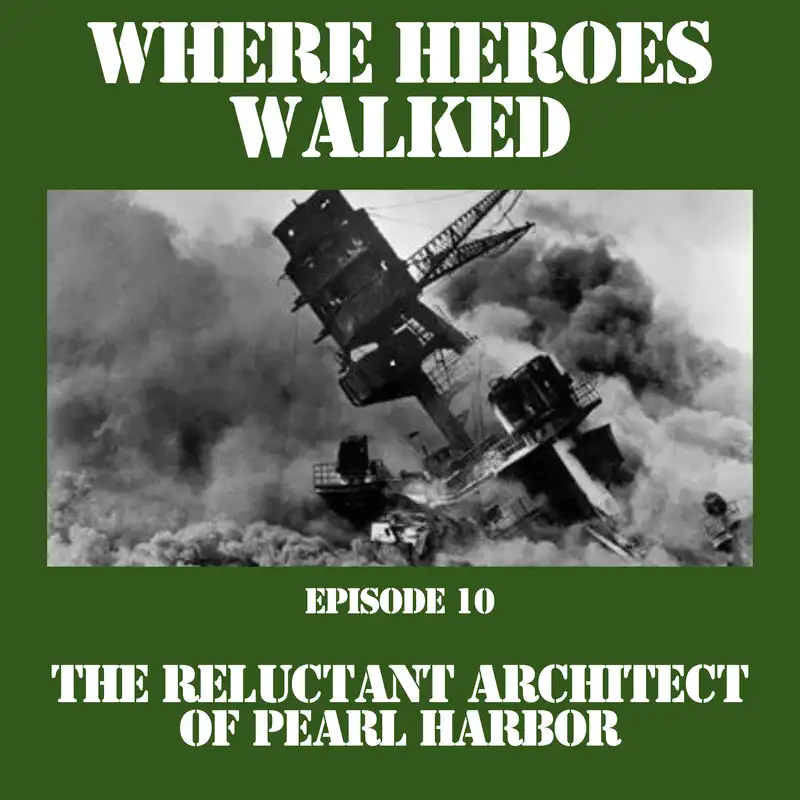
If you know anything of American history, particularly the history of World War II, you are familiar with the the significance of December 7, 1941. On that quiet Sunday morning Japan staged a surprise attack on the American Naval base at Pearl Harbor, Hawaii. The next day, in an address to Congress, President Franklin D. Roosevelt call for a declaration of war, characterizing December 7th as the “day of infamy”.
In the eight decades since debates have raged about whether or not the attack could have been prevented. Hindsight has produced countless theories and accusations.
For the 2,403 Young Americans who lost their life on that day theories, accusations and hindsight don’t matter. They were simply young men and women serving their country in a faraway place who found themselves in the opening chapter of America's entrance into a global war. In just a few short hours, Pearl Harbor, which must have seemed to be a Pacific paradise, became a hell on earth. That Hell on Earth would multiply in horror many times over as America would eventually see 400,000 of its best and brightest die on battlefields around the world. Even that would pale to the staggering number of world citizens that would die in the ongoing six year conflict with estimates running anywhere from 60 to 100 million.
As for the Japanese attack, it was a bold and--as many critics and historians maintain--foolish act of desperation. In the end it would prove to be the high point of an imperialistic campaign that had seen Japan run rampant throughout far East during the 1930s.
So, what’s the story behind the attack on Pearl Harbor.
Fed by a nationalistic fervor that had taken root in the late 1920s, the island nation had invaded and subjugated Manchuria in 1933. The League of Nations then censured Japan prompting Japan to withdraw from the League of Nations and just intensify its aggression. Japan then turned its eyes toward China, mounting a full-scale invasion of the mainland in 1937 and slaughtering untold millions of Chinese, both military personnel and innocent civilians. On September 27,1940 Japan entered into what was known as the Tripartite Pact, a non-aggression treaty with Germany and Italy. The dictatorial powers of the world were now aligned with one purpose; Bring the free world under their control.
As Japan was undertaking this imperialistic campaign, the United States was tightening the screws on exchanges of goods. Soon Japan was being starved by a very effective embargo on raw goods—especially oil—as punishment for their actions. War with the United States seemed an inevitable course of action and military leaders began developing a war plan, a plan built upon the foundation of striking the first blow.
The responsibility for the planning of that opening salvo would fall upon the shoulders of one of the brightest and best Japanese commanders, Isoroku Yamamoto. Yamamoto, however, took on the responsibility more as a patriotic duty than as the result of the "war fervor" many of his fellow military leaders were driven by.
Yamamoto had a different take on Americans than many of his countrymen. He had spent several years in the United States starting in 1920s and 30s, studying English at Harvard and traveling the United States extensively as a naval attaché.
He was keenly aware of America’s industrial might and his conversations and correspondences with fellow military leaders made it clear that he believed a prologue war with United States could not be won. He urged Japanese leaders to reconsider, much to the dismay of pro-war militants. During the late 1930s his life was in constant danger of assassination.
“If we are ordered to do it," Yamamoto reportedly told the Prime Minister in September 1940, “…I can guarantee to put up a tough fight for the first six months, but have absolutely no confidence as to what would happen if it went on for two or three years.”
The reluctant Yamamoto believed that the only possible way to win a war with the U.S. would come by striking a sudden and decisive blow to cripple the American naval fleet, and in particular, the US aircraft carrier force, at Pearl Harbor. Ideally, such a blow would buy precious time for Japan to capture areas containing needed resources without the interference of the United States.
Yamamoto was also deeply concerned with the timing of the attack. Once again, having spent time in the United States and understanding the American people as he did, he knew the Americans were not the weak, cowardly people Japanese propagandists had characterized them as to the Japanese public. He knew they would fight back and fight back tenaciously.
The timetable had been set to deliver a declaration of war prior to the attack on Sunday, December 7. Yamamoto knew that nothing would ignite the indignation and anger of the American people as would a seemingly unprovoked peace time attack.
Yet as we know, that is exactly what happened. Complication piled upon complication, delay piled upon delay, all of which caused the war ultimatum to be delivered more than an hour after the attack has commenced. The failure to deliver the declaration of war before bombs fell on Pearl Harbor greatly distressed Yamamoto.
But Yamamoto’s timetable wasn’t the only costly stumble in the battle that would propel the United States into the war. The United States suffered their own.
There were countless warning signs that pointed not just to an attack on Pearl Harbor but to almost the exact date and time. Those warning signs were unfortunately ignored. While the scope and specifics of those warnings are too vast to detail in this podcast episode there are several books I would recommend for those interested in pursuing further and you can find those recommendations in the show notes below.
It has become more legend than truth that Yamamoto said; ”l fear all we have done is to awaken a sleeping giant". There is no record of Yamamoto ever saying or writing such a statement. More likely than not, it is the work of a Hollywood screenwriter, possibly for the movie "Tora! Tora! Tora!".
Regardless, it is clear through his journals and correspondence that Yamamoto felt such a sentiment and said so in other words. He knew Japan was in for a very difficult battle in trying to beat the Americans. He knew, especially given the fact that they considered Pearl Harbor an unprovoked, surprise attack, that the American people would arise with what Roosevelt call "righteous indignation". He knew the prolonged war would be simply impossible to win given the Americans’ Industry, manpower, and most of all resolve.
Yamamoto himself would become a victim of American resolve and ingenuity. On April 14,1943 American intelligence officers decoded a classified message indicating that Yamamoto would be traveling from Rabaul to an air field near Bouganville in the Solomon Islands on the 18th. The plan was set in motion, and knowing Yamamoto's penchant toward punctuality American planes were able to intercept his flight at an exact location and precise moment. The American planes riddled Yamamoto’s sending it plummeting in flames to the jungle below. His body was found the next day and he was returned to Japan and given the heroes funeral.
It would prove to be a rather ignominious end to the man who is the reluctant architect of the Pearl Harbor attack.
————————————————————————————-
If you are looking for more information on Pearl Harbor, there are several books I would recommend. First I would recommend, At Dawn We Slept by Gordon W. Prange, Day of Infamy by Walter Lord, And I Was There by Rear Admiral Edwin T. Layton, and Two Ocean War by Samuel Eliot Morison. These are older books but contain very worthwhile examinations of the saga of Pearl Harbor. Of course, there are newer books as well as countless documentaries, Youtube pages, and movies.
Thank you for joining me for this 10th Episode of Where Heroes Walk: The Faces, the Places, and the Stories of World War II.
If you liked what you heard or were inspired to dig deeper into the history of World War II, than PLEASE like, share, or subscribe to the podcast. Also, please comment or email me at ron@roneckberg.com.
Thanks again for listening! I’ll look forward to being with you on episode 11 of Where Heroes Walked: The Faces, the Places, and the Stories of World War II.